
Paper, as medium and metaphor, lies at the heart of this exhibition. It is the surface upon which devotion, thought, and experimentation converge, bearing both the sacred imprints of history and the cerebral gestures of modernity.
In the late nineteenth century, Raja Ravi Varma’s lithographs changed the landscape of Indian art. His prints brought the divine from temple to threshold, transforming paper into a democratic space for spiritual engagement. Through the press, myth became modern, and beauty became shared.
Over a century later, Tongji Philip Qian continues this lineage through the language of chance and craft. His woodblock prints, born from disciplined play and deliberate uncertainty, question the nature of repetition, authorship, and order. Here, the press is not only a tool but a site of meditation, where the artist’s hand becomes an instrument of inquiry.
Together, their practices trace the continuum of printmaking, from the lithographic stone to the carved woodblock, from devotion to design, from image to idea. In doing so, they reaffirm the timeless role of paper as a vessel of human thought, fragile yet enduring, silent yet deeply eloquent.
Echoes on Paper: Continuities of Craft and Consciousness invites viewers to consider the print not as replication, but as revelation. It is a reminder that every impression whether born of faith or of philosophy carries within it the echo of its maker, and the memory of its moment.
At once sacred and cerebral, tangible and conceptual, Echoes on Paper: Continuities of Craft and Consciousness brings together two artists separated by time and geography yet united by their shared devotion to the act of impression—the meeting of material, method, and mind.
This exhibition celebrates the enduring continuum of printmaking: not merely as a process of reproduction, but as a philosophy of transmission, transformation, and touch.
Raja Ravi Varma, the visionary “Painter Prince” of India, pioneered a new visual language by merging European academic realism with Indian mythological tradition. His mastery of form, perspective, and narrative gave rise to images that bridged court and common home alike. Through the establishment of his lithographic press in the late nineteenth century, Varma democratised art, bringing the divine into domestic spaces and translating spiritual devotion into accessible, printed form. His oleographs were not simply reproductions, they were acts of cultural renewal, making beauty and divinity tangible through the medium of paper.
Tongji Philip Qian, a contemporary multidisciplinary artist and educator, reinterprets printmaking as a conceptual and meditative discipline. Through his chance-based woodblock prints, he examines the intersections of order and accident, labour and intuition. Using self-devised algorithms guided by dice, Qian relinquishes authorship to process, inviting randomness, repetition, and reflection into his practice. His work transforms the print from a mechanical impression into a living inquiry — a dialogue between material and meaning.
“Like ink meeting paper, this Biennale brings memory, labour, and spirit together. Rooted in India’s many traditions, print here becomes samskara—an impression that carries time, touch, and thought into the future,” says Dr. Nand Lal Thakur, Vice Chairman, Lalit Kala Akademi, New Delhi.
“Together, these two artists reveal how printmaking has evolved from devotional imagery to philosophical experimentation. Through stone, wood, and paper, they articulate a shared language—one of craft, contemplation, and continuity. Echoes on Paper: Continuities of Craft and Consciousness traces this journey, presenting printmaking as both archive and awakening: a bridge between past and present, faith and intellect, hand and idea,” shares Jalpa H Vithalani, Curator and Founder, Cosmic Heart Gallery.
“It is an honor to collaborate with Cosmic Heart Gallery for the third time in Mumbai thanks to Jalpa’s leadership and her commitment to the international communities. Woodblock printmaking, as the medium which underpinned the beginning of my career, remains central to my practice due to its physical rigor and historical lineage. Within my multidisciplinary practice, prints and works on paper have always served as the grounding elements.
Placing my prints in dialogue with those of Raja Ravi Varma invites conversations that cross-register geography, artistic histories, and inherited traditions. It is my hope that this transcultural exchange will illuminate a historical understanding of printmaking and open pathways toward future discussions of material and meaning,” shares Tongji Philip Qian, Artist
As viewers move through this dialogue of time and texture, they are invited to reflect on how the medium has endured even as meaning has transformed. The press, once a vessel for the sacred, now also serves as a site for questioning; the printed image, once a symbol of collective belief, now becomes an instrument of introspection. In this continuum, what persists is not the subject alone, but the spirit of making — the quiet assertion that each impression, whether devotional or conceptual, carries within it the pulse of its age, and the permanence of its maker’s intent.
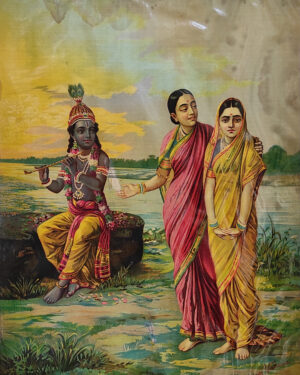
About the Artist — Raja Ravi Varma (1848–1906)
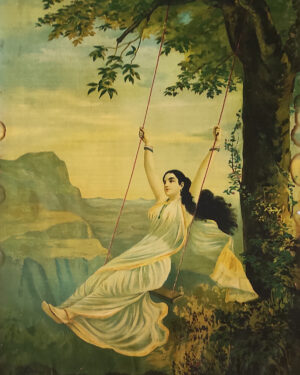
Raja Ravi Varma, India’s revered “Painter Prince”, remains one of the most influential figures in the history of Indian art. Born in 1848 in Kilimanoor, Kerala, he rose to national and international prominence through his remarkable ability to unite European realism with Indian imagination.
Trained in the techniques of portraiture and oil painting, Varma mastered perspective, anatomy, and light with a finesse inspired by the Western academic style. Yet his subjects were profoundly Indian — drawn from mythology, literature, and the lives of everyday people. His compositions brought the gods and goddesses of the Ramayana and Mahabharata into vivid human form, their divinity expressed through emotion, gesture, and detail.
In 1894, his establishment of a lithographic press in Malavli, later relocated to Ghatkopar in Mumbai, revolutionised the Indian art world. At a time when art belonged only to palaces and temples, Varma made it available to the masses. His oleographs — printed reproductions of his paintings — transformed homes into sanctuaries and created a shared visual identity across a newly modern India.
Varma’s work was not only artistic but cultural. His portrayal of women, radiant in silks and jewels, defined the grace and beauty of the Indian feminine ideal. So powerful was his influence that, in the West, a beautiful woman was once described as if she had “stepped out of a Varma canvas”.
More than a century after his passing, his prints remain objects of devotion and historical significance. They stand as a testament to his belief that art, when multiplied, can transcend boundaries — that paper and press can carry divinity, dignity, and the essence of a civilisation forward through time.
About the Artist — Tongji Philip Qian
Tongji Philip Qian is a multidisciplinary artist and the co-founder of TPQ Studio, writer, and educator, whose practice explores the interplay between chance, craft, and consciousness. Born in Shanghai and based in New York, he works primarily with woodblock printing, treating the medium as both material experiment and philosophical meditation.
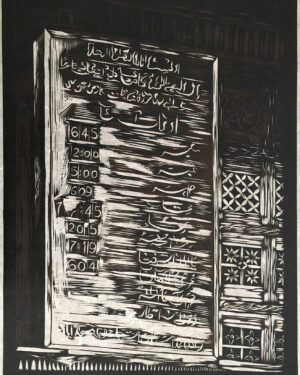
Qian’s process is defined by his engagement with the element of chance. Using dice to determine carving sequences, he creates algorithmic systems that guide each composition. By surrendering control to randomness, he transforms the act of printmaking into a reflection on order, error, and the unseen rhythms that connect human gesture with cosmic pattern.
His work is deeply rooted in the history of craft. Drawing from the early traditions of woodblock printing in rural Asia — where the medium served devotional and communal purposes — Qian reimagines these origins in a contemporary, conceptual framework. Each print is a record of dialogue between the artist, the tool, and the material — a negotiation between design and accident.
Qian holds degrees in Art History, Mathematics, and Fine Art from Carleton College, New York University, and the Rhode Island School of Design.
His work is housed in a number of public collections, such as the Asia Art Archive in America, Center for Book Arts, and the RISD Museum. Qian received his BAs in art history and mathematics from Carleton College and his MFA from the Rhode Island School of Design. Tongji Philip Qian has held teaching positions at Bard College and the Rhode Island School of Design, and is currently on faculty in the Department of Visual Arts at the University of Chicago. Phil is also the founder of the State VIII Project, an artist-run initiative and residency programme in Hyde Park dedicated to fostering dialogue between art and thought.
Through his prints, Qian invites viewers to witness the quiet tension between control and surrender. His art reflects a belief that every impression, however small, imperfect, or random is a record of consciousness: a mark of both human effort and the universe at play.
The Cosmic Heart Gallery
Cosmic Heart Gallery
A Legacy of Art, Vision, and Impact
A sanctuary of creativity in South Bombay, Cosmic Heart Gallery is a space where art transcends time, culture, and geography. Founded by Jalpa H Vithalani in 2012, the gallery has curated over 300 transformative exhibitions, fostering artistic excellence and global cultural exchange.
Among its landmark initiatives is ‘Eye of the Tiger’, a powerful confluence of art and conservation. Conceptualized by Jalpa H Vithalani, this project brought together 200 rural artists from Sawai Madhopur to create 100 breathtaking works, advocating for tiger conservation and sustainable livelihoods. The exhibition has gained national recognition, travelling to The Indian Museum, Kolkata, for its historic 210-year celebration which was inaugurated by Shri Gajendra Singh Shekhawat, Union Minister of Culture and Tourism, where Jalpa’s own evocative tiger paintings were showcased and marked her debut as an artist alongside these masterpieces.
Beyond exhibitions, Cosmic Heart Gallery is a movement, collaborating with institutions like NGMA Mumbai, NGMA Kolkata, NGMA Delhi, J.J. School of Art, Embassy in India Argentine Republic, Consulate General of Argentina and the Iran Culture House and representing India at prestigious forums such as the United Nations and Art Bahrain Across Borders under the patronage of Her Royal Highness Princess Sabeeka Bint Ibrahim Al Khalifa. As a member of the special Task Force of Arts for BPW International, Jalpa continues to foster peace and intercultural understanding across 100 countries.
Each exhibition is a meticulously curated experience, breaking barriers of language and geography to foster a universal dialogue through art. With an unwavering belief in art as a force of transformation, the gallery continues to shape narratives, elevate spaces, and inspire generations.
Here, art is not just displayed—it is experienced, celebrated, and woven into the fabric of history.
About Lalit Kala Akademi
Lalit Kala Akademi (National Academy of Art), New Delhi was inaugurated on 5th August 1954 by the then Minister for Education, Maulana Abul Kalam Azad and was registered under the Societies Registration Act 1860, on 11th March 1957. In pursuance of the objectives set out in the Constitution, the organisation functions through its General Council, Executive Board and other Committees.
Lalit Kala Akademi, the youngest of the three Akademies founded by Govt. of India, establishes to direct its focus on activities in the field of Visual Arts. In his inaugural speech Maulana Abul Kalam Azad had stated “The Akademi must work to preserve the glorious traditions of the past and enrich them by the work of our modern artists”. Akademi has preserved and documented a permanent collection of the highest order that reflects the vitality, complexity and unfolding patterns of contemporary, modern, folk and tribal art in India. Lalit Kala Akademi New Delhi along with its Regional Centres situated at Chennai, Lucknow, Kolkata, Bhubaneswar, Garhi (New Delhi) and sub-centres at Shimla, Ahmedabad, Agartala, Patna presents exhibitions workshops, camps lectures, retrospectives shows and many other art activities of unparalleled significance.
Print Biennale: Celebrating the Art and Evolution of Printmaking in India
A Lalit Kala Akademi initiative, Print Biennale India is one of a kind program, aiming to establish an interactive global platform for Printmaking. It hopes to foster international artistic exchange and academic dialogue. The Print Biennale brings together Printmakers worldwide, creating opportunities to explore new artistic trends and celebrate the diversity, rich history and exciting future of printmaking in India and abroad.
To bring printmaking to the forefront of the fine art scene, Lalit kala Akademi under the leadership of erstwhile Administrator C. S. Krishna Setty, initiated the Print Biennales in 2017.
The vision is to create an exclusive platform where printmakers from across the globe showcase their talent, exchange ideas, and celebrate the richness of this medium. The Biennale has become a confluence of tradition and innovation, inspiring a renewed appreciation for print art. This initiative has since grown into one of the most significant gatherings for printmakers worldwide.
The Akademi has successfully organized the 1st and 2nd editions of the Print Biennale India, with wide participation from artists across India and abroad. We are pleased to announce the launch of the 3rd Print Biennale India in January 2026, an international exhibition dedicated to celebrating the dynamic and evolving art of printmaking—a medium valued for its accessibility and technical richness.
The Akademi has successfully organized the 1st and 2nd editions of the Print Biennale India, with wide participation from artists across India and abroad. We are pleased to announce the launch of the 3rd Print Biennale India in January 2026, an international exhibition dedicated to celebrating the dynamic and evolving art of printmaking—a medium valued for its accessibility and technical richness.